
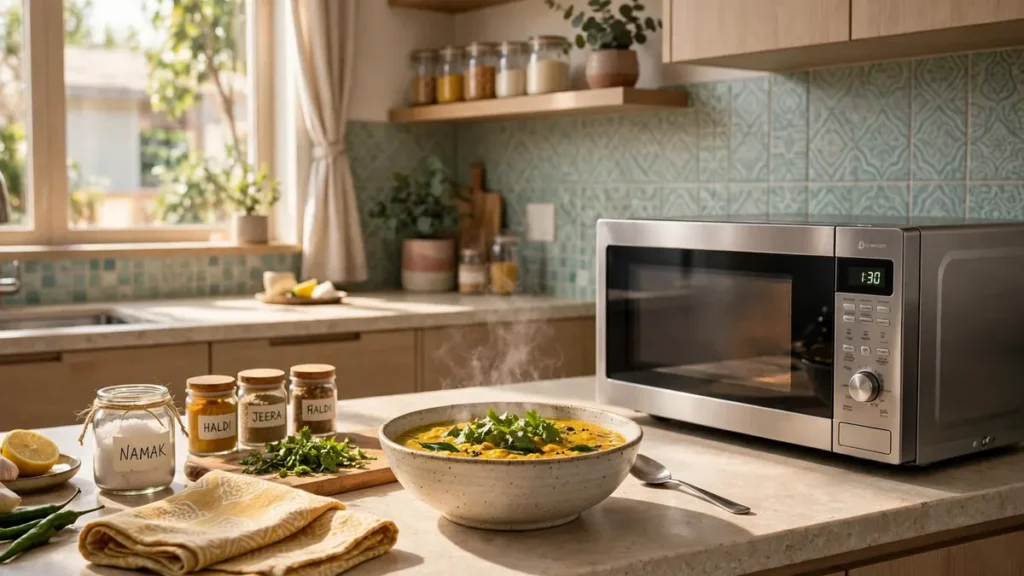
A microwave oven has become a daily tool in Indian kitchens, used to reheat dal and rice, defrost frozen vegetables, warm milk, and bake cakes. It works very differently from a gas stove or an OTG oven: instead of heating from outside, it excites water, fat and sugar molecules inside the food itself, so food heats quickly and evenly from within. Choosing the right microwave oven is about type, capacity and the cooking a household actually does, not about collecting features that stay unused.
Answer: Which Microwave Oven Suits an Indian Kitchen?
For most Indian kitchens, a 28 to 32 litre convection microwave oven suits a family of four to six that bakes, grills and reheats, while a 20 to 23 litre solo model suits one or two people who mainly reheat and defrost. Choose convection only if the household will bake and grill; otherwise a solo model saves counter space.
What Are the Main Types of Microwave Ovens?
A solo microwave oven heats and defrosts only. It suits reheating leftovers, warming milk, steaming vegetables and defrosting frozen food, and it is the most affordable type. Its limit is clear: it cannot brown, crisp or bake, so rotis stay soft and cakes do not rise properly in it.
A grill microwave oven adds a heating element on top of the cavity, so it can grill paneer tikka, toast sandwiches and brown the top of a dish. It suits households that want occasional grilling without a separate OTG, though it still cannot bake a cake evenly because it lacks a fan to circulate hot air.
A convection microwave oven adds a fan and a heating element that circulate hot air around the cavity, so it can bake cakes, cookies and bread, roast vegetables and grill, in addition to all solo functions. It is the most versatile type and the usual recommendation for a family that cooks widely, but it costs the most and needs more counter space. A microwave oven with an air-fryer mode is a newer convection variant that crisps food with less oil, though results vary by model and portion size.
The history of the microwave oven traces the appliance from radar research to the kitchen counter, and the science of dielectric heating explains how microwaves excite water molecules to produce heat inside food.
What Capacity Does Your Family Need?
Microwave capacity is measured in litres, and the right size depends on family size and the dishes cooked. A 17 to 20 litre model suits one or two people and small kitchens, handling single plates, cups of milk and small bowls. A 23 to 28 litre model suits a family of three to four, fitting a medium casserole and a full dinner plate comfortably. A 30 to 32 litre model suits a family of five or more and handles large vessels, whole chicken roasting and baking trays.
Capacity alone does not decide usefulness: the turntable diameter matters too, because a wide plate or a large baking dish must rotate freely without touching the cavity walls. Measure the largest vessel the household uses regularly, then check the turntable size before deciding. If the kitchen counter is small, a compact model that is actually used beats a large model that stays pushed into a corner.
How Does a Microwave Oven Compare With an OTG?
A microwave oven heats food fast from within and excels at reheating, defrosting and steaming, while an OTG (oven, toaster, griller) heats from elements above and below and excels at baking, toasting and slow roasting. A convection microwave covers much of an OTG’s range, which is why many Indian homes now choose one appliance instead of two, but a dedicated OTG still bakes large cakes and bread more evenly and costs less than a convection microwave of similar size.
The practical question is what the household cooks most. A home that reheats daily and bakes occasionally is well served by a convection microwave. A home that bakes bread and large cakes weekly may still prefer a separate OTG alongside a simple solo microwave. Households that mainly reheat need neither grilling nor convection, and a solo model is the sensible choice.
Which Utensils Are Safe in a Microwave Oven?
Glass, ceramic and microwave-safe plastic containers are safe, provided they carry no metallic trim, gold rim or foil cover. Metal vessels, steel plates, aluminium foil and metal-trimmed crockery must never go inside, because metal reflects microwaves, causes sparking and can damage the magnetron. Paper towels and microwave-safe covers are useful for splatter control, but brown paper bags and recycled paper can catch fire and should stay out.
When reheating, use a shallow, wide vessel rather than a tall narrow one, because food heats more evenly with a larger surface area. Stir halfway through reheating, since microwaves can leave hot and cold spots, especially in dense foods like dal and rice. Let food stand for one to two minutes after the timer ends, because heat continues to spread during standing time and the centre finishes cooking.
How Do You Use a Microwave Oven for Indian Cooking?
A microwave oven reheats rice, dal, sabzi and curries in minutes, and it defrosts frozen peas, paneer and meat far faster than leaving them on the counter. Steaming vegetables in a covered glass bowl with a spoonful of water keeps colour and nutrients better than boiling them in a large pot. Warming milk, melting butter and softening jaggery are small jobs where the microwave saves both time and washing up.
For baking, a convection model handles cakes, muffins and cookies well if the recipe’s temperature and time are followed and the dish is placed on the rack, not directly on the turntable, where browning suffers. Grilling paneer tikka, kebabs and sandwiches works best in small batches with space between pieces, so hot air reaches every side. Rotis and parathas, however, stay best on a tawa, because the microwave softens them instead of crisping them.
If the kitchen is being planned or rearranged, kitchen layouts with a dedicated appliance corner show where a microwave sits safely with ventilation and a nearby power point, and storage ideas that keep microwave vessels within reach keep glass bowls, covers and racks in one spot. A microwave that lives beside the fridge also pairs well with planning a kitchen around a refrigerator space thinking, because reheating usually starts with food taken out of cold storage.
How Do You Clean and Maintain a Microwave Oven?
Wipe spills at once with a damp cloth, because dried curry and milk splatter bake harder with every use and start to smell. For a deep clean, heat a bowl of water with lemon slices for three to five minutes, let the steam loosen grime for another five minutes, then wipe the cavity, door and turntable with a soft cloth. Remove the turntable and roller ring and wash them separately with mild soap, and clean the door seal, because food trapped in the seal can stop the door closing fully.
Never use steel wool, harsh chemicals or abrasive pads inside the cavity, since scratches on the coating invite rust. If the door, latch or seal is damaged, stop using the oven and get it repaired, because the door assembly is part of the safety system that contains microwaves. Keep the vents at the back and sides clear, and never cover the oven with a cloth while it runs.
For the wider home, the same tidy-system thinking applies beyond the kitchen: simple systems that keep a kitchen tidy reduce daily friction, and interior choices for a kitchen corner help a large appliance blend into the room instead of dominating it.
What Mistakes Damage a Microwave Oven?
Running the oven empty, putting metal inside, sealing containers airtight so steam builds pressure, and reheating food in thin single-use plastic are the habits that damage a microwave oven or ruin food. Another is ignoring a damaged door seal or a turntable that no longer rotates, which leads to uneven cooking and, over time, strain on the magnetron. Heating food in a closed container with a tight lid can also burst and splatter the cavity.
A microwave oven is a ten-year appliance with normal use, so the right type, the right capacity and a habit of wiping spills at once are worth more over its life than a long feature list that the household never uses.
Key Takeaways
- Solo models reheat and defrost; grill models add browning; convection models bake, grill and reheat, and suit families that cook widely.
- Match capacity to family size: 20 to 23 litres for one or two people, 23 to 28 litres for three to four, 30 to 32 litres for five or more.
- Never put metal, foil or metal-trimmed crockery inside; use glass, ceramic or microwave-safe plastic.
- Stir food halfway through reheating and let it stand one to two minutes so heat spreads evenly.
- Clean with steam from lemon water, wipe spills at once, and never run the oven empty or with a damaged door seal.
- Rotis and parathas stay best on a tawa; the microwave excels at reheating, defrosting, steaming and baking.
FAQs
What size microwave oven is best for a family of four?
A 23 to 28 litre microwave oven suits a family of four, fitting a medium casserole and a full dinner plate, while a 30 to 32 litre convection model is better for larger families or frequent baking.
Is a convection microwave oven better than a solo microwave oven?
A convection microwave oven is better for households that bake, grill and roast, while a solo microwave oven is better for households that mainly reheat and defrost, because it costs less and takes less counter space.
Can steel utensils be used in a microwave oven?
Steel utensils must never be used in a microwave oven, because metal reflects microwaves, causes sparking and can damage the magnetron; glass, ceramic and microwave-safe plastic are the safe choices.
How do you clean a microwave oven?
Heat a bowl of water with lemon slices for three to five minutes, let the steam loosen grime, wipe the cavity, door and turntable with a soft cloth, and wash the turntable and roller ring separately with mild soap.
Why does food heat unevenly in a microwave oven?
Food heats unevenly because microwaves create hot and cold spots, especially in dense foods, so stirring halfway through, using a shallow wide vessel, and letting food stand for one to two minutes after heating gives even results.