
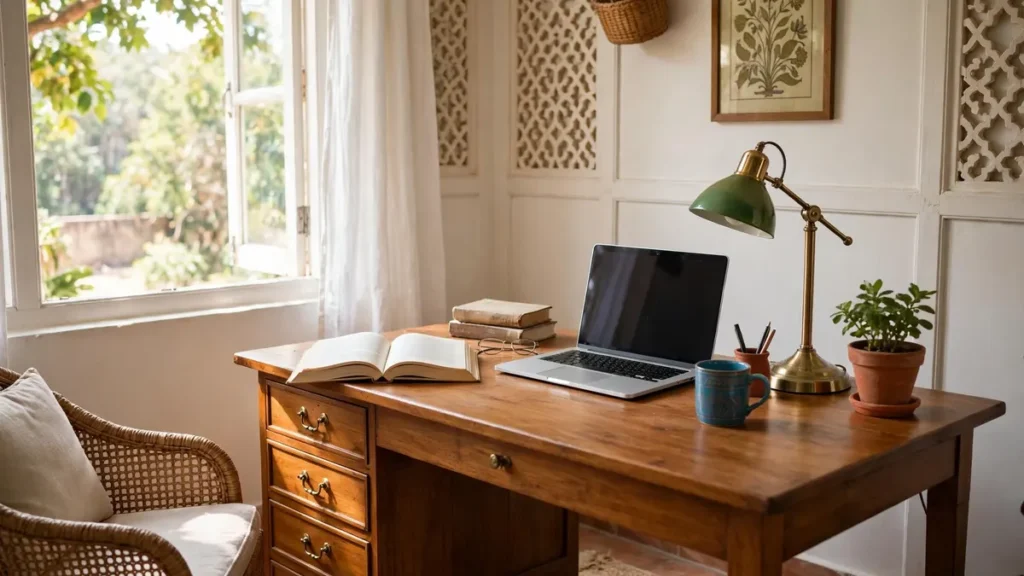
A study table is where homework, exam preparation, office work and online classes happen in most Indian homes, often in a shared bedroom or a corner of the living room rather than a separate study. Because the same table may serve a school student in the afternoon and a working parent in the evening, it needs to suit more than one user and more than one kind of work. A table that is too small forces books onto the bed, a table at the wrong height causes back and neck strain over months, and a table without storage gathers clutter until there is no space left to write. Choosing the right size, storage and position turns a corner into a place where work actually gets done.
Answer: Which Study Table Suits an Indian Home?
For most Indian homes, a wooden study table with drawers and a width that fits a laptop plus an open book suits students and home workers best. A table around four feet wide suits a single user, a foldable table suits a small room, and drawers keep supplies inside the table. Set the height so elbows rest comfortably while writing.
What Are the Main Types of Study Tables?
A study table with drawers is the most practical choice for a shared Indian home, because drawers hold notebooks, stationery, chargers and documents out of sight. A table with two or three drawers on one side keeps the writing surface clear, while a drawer under the centre holds small items like pens and geometry tools. The trade-off is knee space: deep drawer units on both sides leave little legroom, so a single-side drawer unit suits most users better than a double-pedestal design.
A wooden study table, often in sheesham, teak or engineered wood with a wooden finish, suits a home that wants a sturdy table that lasts through school and college years. Solid wood handles weight well and can be repaired, while good engineered wood costs less and stays stable in humid weather if its edges are sealed. The history and design of a desk explains how writing desks developed from simple tables into the drawer and shelf designs used today, and the science of comfortable work posture explains why table height, chair height and screen position affect comfort over long hours.
A wall-mounted or foldable study table suits a small room or a rented home, because it folds away when not in use and leaves floor space open. It works well for a laptop and a notebook, but it rarely holds the weight of many books, so it suits a secondary study spot better than a main one. A corner study table uses two walls at once and suits a bedroom corner that would otherwise stay empty, though the corner seat can feel closed in if a bookshelf hangs directly above it.
A computer table with a keyboard tray and a CPU shelf is a different piece of furniture from a study table, even though shops sometimes sell them under the same name. A keyboard tray sits too low for comfortable writing by hand, and a CPU shelf wastes space for a student who works mainly with books. For a student who also uses a computer, a plain study table with space for a laptop on the surface works better than a specialised computer table.
What Size Study Table Does a Student Need?
Width decides what fits on the surface at once. A student who works with a textbook, a notebook and a laptop at the same time needs a wider surface than a student who uses only a laptop, because books spread out and a cramped surface leads to constant rearranging. A table around four feet wide suits most single users, while a narrower table around three feet suits a small room if books are kept on a shelf beside the table rather than stacked on it.
Depth matters just as much: a shallow table forces the book or laptop close to the edge and leaves no room for a water bottle or a pencil stand, while a deep table pushes the chair far from the wall and eats floor space. A depth that holds an open book plus a pencil stand, with the laptop screen at a comfortable reading distance, is the practical target. When a bedroom is small, small bedroom layouts that fit a study corner show how a table, a bed and a wardrobe can share one room without blocking movement.
Height is the most overlooked measurement. A table that is too high forces shoulders up while writing, and a table that is too low makes the user hunch over books. The right height lets the forearms rest roughly level while writing, with feet flat on the floor. Because children grow, an adjustable chair matters more than an adjustable table: set the chair so feet rest flat, then check that the table height still works. If the chair must be raised high for a young child, a footrest keeps the sitting position comfortable until the child grows taller.
Where Should a Study Table Be Placed?
Place the study table near a window when possible, because natural light reduces eye strain during daytime study and makes a small corner feel open. The table should sit beside the window rather than directly facing it, so glare does not fall on the book or screen and the user is not distracted by movement outside. If the only spare wall faces a busy part of the home, a bookshelf or a room divider between the table and the rest of the room gives the study corner a sense of separation without building a wall.
Lighting for evening study needs a dedicated lamp, because a ceiling light alone throws shadows across the page from the user’s own head and hands. A desk lamp on the opposite side of the writing hand lights the page without the hand casting a shadow, and a warm-white bulb suits long reading sessions better than a harsh white one. A lamp with an adjustable arm lets the same table serve a student writing by hand and a parent working on a laptop.
Power points decide the practical position more often than the ideal one. A laptop, a lamp and a phone charger need a nearby socket, and a table placed far from one ends up with cables crossing the floor. When a home is planned or a room is rearranged, a home planned with a quiet study corner keeps a power point, a light point and a bookshelf together in the study corner from the start.
How Do You Organise a Study Table?
Start by removing everything from the surface, then return only what is used daily: the current books, a pencil stand, a lamp and a water bottle. Everything else — old notebooks, extra stationery, chargers for other devices — belongs in a drawer, on a shelf, or in another room. A clear surface is not about tidiness for its own sake; it is about starting work without ten minutes of clearing space first. a tidy system for study supplies shows how labelled boxes and drawer dividers keep supplies sorted in a shared room.
Drawers work best with a simple division: one drawer for writing tools and small stationery, one for notebooks and papers, and one for chargers and cables. A small tray inside the top drawer stops pens and clips from mixing into one tangled layer. A wall shelf above the table holds reference books and keeps them off the surface, but it should sit high enough that the user does not hit their head when standing up, and heavy books belong on a lower, sturdier shelf rather than a high one.
A weekly reset keeps the system working. At the end of the school or work week, return borrowed items, file loose papers into a folder, and clear anything that has drifted onto the table from elsewhere in the room. Five minutes of resetting on a Sunday evening saves far more time during the week than any organiser bought once and never maintained. For a study corner that shares a bedroom, interior choices for a study corner show how a calm wall colour and a simple pinboard make the corner feel like a study space rather than a leftover corner.
What Mistakes Shorten a Study Table’s Useful Life?
Choosing the cheapest table without checking its frame is the most common mistake, because a wobbly table makes writing uncomfortable and eventually fails at its joints. Check that the legs are level, the top does not flex when pressed in the centre, and the drawers slide smoothly when loaded with books. A table that wobbles in the shop will wobble worse at home on an uneven floor.
Ignoring chair pairing is another mistake: a good table with a dining chair at the wrong height causes the same strain as a bad table. Pair the table with a chair that supports the lower back, lets feet rest flat, and slides fully under the table when not in use. Overloading the table with books, a printer and a monitor also shortens its life, because most study tables are built for writing weight, not for a full office setup. Heavy equipment belongs on a separate sturdy unit.
Finally, placing the table against a damp wall or beside a frequently splashed area damages wooden tops and engineered boards over time. A small gap between the table and the wall lets air circulate and makes cleaning behind the table possible, and a mat under a water bottle protects the top from rings and spills. When money is tight, spending on a sturdy table and a good chair beats spending on extra shelves and accessories that stay empty: refreshing a study corner without overspending shows where to spend first when setting up a study corner on a budget.
Key Takeaways
- A wooden study table with drawers suits most Indian students and home workers.
- A width around four feet fits a laptop plus open books; narrower tables suit small rooms with a nearby shelf.
- Set chair height so feet rest flat, then check that the table height lets forearms rest level.
- Place the table beside a window for natural light, with a desk lamp for evening work.
- Keep only daily items on the surface; drawers and a wall shelf hold the rest.
- A weekly five-minute reset keeps the study corner usable all week.
FAQs
What size study table is best for a student?
A study table around four feet wide suits most students, because it holds an open textbook, a notebook and a laptop at once, while a narrower table around three feet works in a small room if books are kept on a nearby shelf instead of stacked on the table.
Is a study table with drawers better than one without?
A study table with drawers is better for a shared room, because drawers keep notebooks, stationery and chargers inside the table and the writing surface clear, while a table without drawers needs a separate shelf or box for the same supplies.
Which is better, a wooden study table or an engineered wood study table?
A wooden study table in solid wood lasts longer and can be repaired by a carpenter, while a good engineered wood study table costs less and stays stable in humid weather if its edges are sealed, so the choice depends on budget and how long the table must last.
How do you organise a study table for a small room?
Clear the surface to daily items only, use one drawer for stationery and one for notebooks, add a wall shelf above the table for reference books, and reset the table once a week so supplies from elsewhere in the room do not drift back onto it.
What chair height suits a study table?
The chair height that suits a study table is the one that lets feet rest flat on the floor while forearms rest roughly level on the table surface, with a footrest for a young child whose feet do not yet reach the floor.