
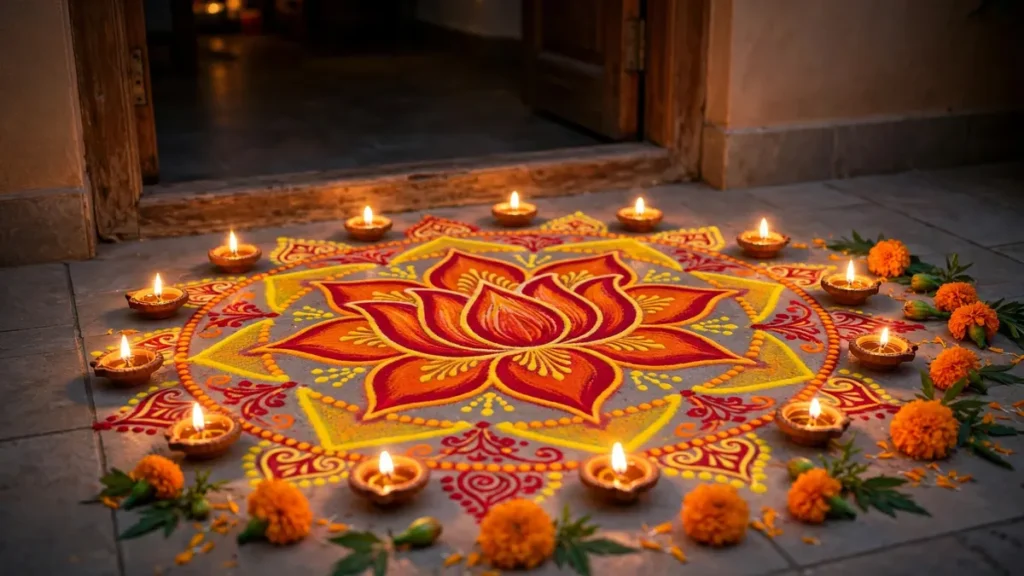
Rangoli designs are decorative floor patterns made with coloured powder, rice flour, flower petals or chalk, drawn at doorways and courtyards to welcome guests and mark celebrations. The most loved styles include simple geometric patterns for daily use, flower rangoli for festivals, and dot-grid patterns for large, symmetrical creations.
What Are Rangoli Designs?
A rangoli is a traditional Indian floor art form drawn at the entrance of a home, in a courtyard, or around a diya during festivals. The word comes from Sanskrit, and the practice is known by different names across India: kolam in Tamil Nadu, muggu in Andhra Pradesh and Telangana, alpana in West Bengal, and mandana in Rajasthan. Each region has its own style, but the purpose stays the same — a beautiful, welcoming pattern that marks a home as ready for celebration.
Rangoli powder is the most common material, sold in bright colours at every market before Diwali. Rice flour is the traditional choice, especially for daily kolam patterns, because it is eco-friendly and feeds small birds and insects. Chalk powder works well on dark floors, while flower petals give a rich, fragrant finish for weddings and pujas. Many households mix materials, using powder for the outline and petals for the fill.
Which Simple Rangoli Designs Suit Small Spaces?
Simple rangoli designs are the best starting point for a small doorway or balcony. A small circle with eight petals, a four-point star, or a paisley motif near the door takes only ten to fifteen minutes and still looks festive. The trick is to keep the design compact and balanced: one central motif, a clean border, and two or three colours at most.
For apartment entrances, a semi-circle design that hugs the door frame works better than a full circle that spills into the walkway. Stencils and sticker rangoli are also practical for small flats, since they give a neat result in minutes and can be reused through the festive season. Pairing a small rangoli with a row of diyas on either side makes the whole entrance look complete without needing a large pattern.
How Do You Make Rangoli Designs for Diwali?
Rangoli designs for Diwali are usually the grandest of the year, because Diwali celebrates the return of Lord Rama to Ayodhya and the welcome of Goddess Lakshmi into the home. A classic Diwali rangoli features a large lotus, a diya motif, or a peacock, surrounded by concentric borders in red, yellow, orange and pink.
Start by cleaning and drying the floor, then mark the centre point and draw the outline in white powder before adding colour. Working from the centre outward keeps the pattern symmetrical, and filling one section at a time stops colours from mixing. For the finishing touch, place small diyas along the border and a few marigold petals at the centre — the light from the diyas makes the colours glow in the evening. If you love decorating the whole entrance for the festival, henna patterns for festive hands add a matching traditional touch for everyone celebrating at home.
What Are Flower Rangoli Designs?
Flower rangoli designs use fresh petals instead of powder, and they are a favourite for weddings, pujas and Diwali mornings. Marigold is the most popular choice because its orange and yellow petals are bold and long-lasting, while rose petals add deep red and pink accents. Jasmine, chrysanthemum and orchid petals bring white, purple and soft pink tones.
A simple flower rangoli starts with a circular base of marigold petals, a ring of rose petals inside it, and a small brass diya or a jasmine cluster at the centre. Because petals are heavier than powder, flower rangoli holds its shape well even in a light breeze, which makes it ideal for outdoor entrances. The one drawback is time: petals wilt after a day, so flower rangoli is best made on the morning of the celebration itself. For a full festive home look, cozy fall home decor ideas can inspire how the entrance, living room and balcony come together as one warm seasonal display.
How Do Rangoli Designs With Dots Work?
Rangoli designs with dots, known as pulli kolam in South India, begin with a grid of dots marked on the floor. The artist then joins the dots with straight or curved lines to form geometric patterns, stars, birds or lotus shapes. A 5 by 5 dot grid suits first-timers, while experienced artists work with 9 by 9 or larger grids for complex designs.
The dot method is popular because it guarantees symmetry: as long as the dots are evenly spaced, the pattern stays balanced. Chalk or rice flour dots are marked first, then the lines are drawn in one continuous flow where possible. Many women draw a small dot kolam outside the door every morning as a daily ritual, and save the large dot-grid designs for Fridays and festivals. For daily festive dressing to match the entrance, kurti neck designs for festive occasions offer ethnic neckline styles that pair naturally with a home dressed for celebration.
What Makes Traditional Rangoli Designs Special?
Traditional rangoli designs carry meanings that go beyond decoration. The lotus stands for prosperity, the peacock for beauty and grace, the swastik for good fortune, and the diya for the victory of light over darkness. In many homes, the rangoli is drawn by the women of the house each morning as a sign of hospitality, and the design changes with the season and the festival.
Regional styles give traditional rangoli its variety. Kolam patterns from Tamil Nadu are geometric and drawn with rice flour in white, often with intricate loops around dots. Alpana from Bengal uses a white rice paste on red earth for weddings and Lakshmi Puja. Mandana art from Rajasthan features bold white patterns on mud-plastered walls and floors. Learning one regional style deeply is more rewarding than copying many styles shallowly, because each has its own rhythm and rules. The way these styles have travelled from village courtyards to modern apartments mirrors the wider evolution of Indian fashion, where old crafts keep finding fresh, modern forms. When the whole house is being dressed up for a festival, budget home decor ideas show how to refresh every room beautifully without overspending, and the rangoli becomes the centrepiece of that effort.
Key Takeaways
- Rangoli designs are floor patterns made with powder, rice flour, petals or chalk to welcome guests and mark celebrations.
- Simple geometric patterns suit small entrances and first-timers; dot grids guarantee symmetry for larger designs.
- Diwali rangoli traditionally features lotus, diya or peacock motifs in red, yellow, orange and pink.
- Flower rangoli looks richest for weddings and pujas but should be made on the morning of the event, since petals wilt.
- Regional styles like kolam, muggu, alpana and mandana each carry their own motifs and meanings.
- Start from the centre, work outward, and finish with diyas or marigold petals for a complete festive entrance.
Frequently Asked Questions
What is the easiest rangoli design for first-timers?
A small circle with eight petals is the easiest rangoli design for first-timers. Draw a circle in white powder, add eight oval petals around it, fill them with two colours, and outline the whole pattern with a thin white border for a neat finish.
Which colours are best for Diwali rangoli?
Red, yellow, orange, pink and white are the best colours for Diwali rangoli. These bright shades match the festival’s diyas and marigolds, and they show up beautifully on both light and dark floors in evening light.
How long does a powder rangoli last?
A powder rangoli lasts one to three days indoors if it is not walked over or exposed to wind. Outdoors, it may last only a day, which is why many households redraw the entrance pattern each morning during festival weeks.
Can rangoli be made on tiles and marble floors?
Yes, rangoli works well on tiles and marble floors. Use dry powder or petals on smooth surfaces, avoid wet paste on polished marble, and place the design away from the main walking path so it stays intact longer.
What is the difference between rangoli and kolam?
Kolam is the Tamil Nadu name for rangoli, traditionally drawn with rice flour in white geometric patterns around dots. Rangoli is the broader term used across India, covering coloured powder designs, flower patterns and regional styles like alpana and muggu.