
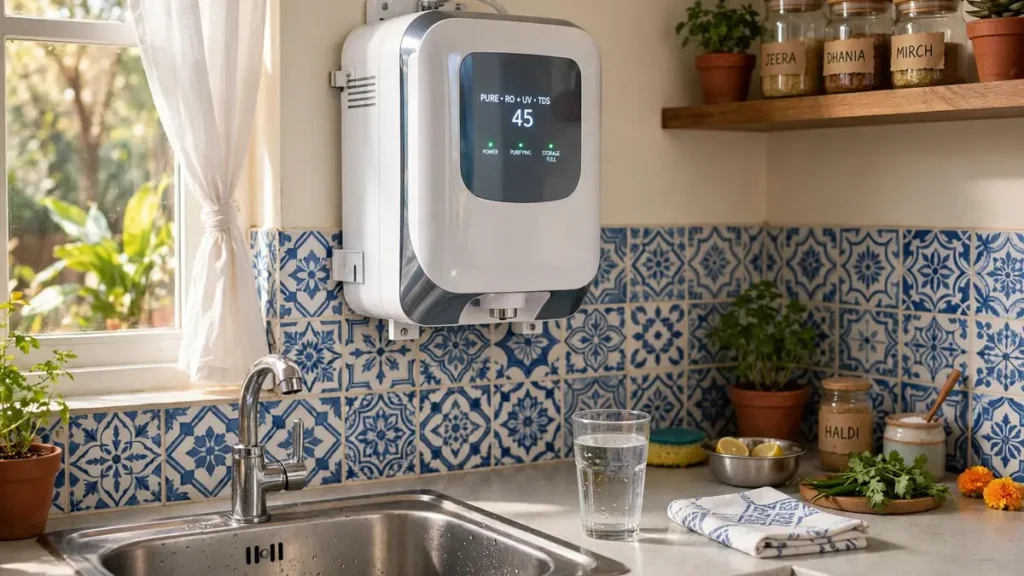
Clean drinking water is a daily concern in most Indian homes because tap water quality changes from city to city, and even from season to season. Municipal water may carry chlorine and sediment, borewell water often carries dissolved salts and hardness, and tanker water can vary with every delivery. A water purifier removes the impurities that matter for your water source, but no single model suits every home. The right choice depends on your water source, its dissolved salt level, family size, kitchen space and how regularly filters are changed.
Answer: Which Water Purifier Suits an Indian Home?
For most Indian homes, an RO water purifier suits high-salt borewell or tanker water, while a UV purifier suits low-salt municipal water. A UV plus UF combination suits treated municipal water with sediment, and a gravity purifier suits homes without steady power. Test your water source first, then match the purification stages to what is actually in the water.
What Are the Main Types of Water Purifiers?
An RO water purifier, short for reverse osmosis, pushes water through a fine membrane that removes dissolved salts, heavy metals and many other dissolved impurities. It suits borewell and tanker water where dissolved salts make water taste salty or leave white deposits on vessels. Because RO also removes some useful minerals, many RO models add a mineral cartridge that puts a small amount of minerals back into the purified water.
A UV water purifier uses ultraviolet light to kill bacteria and viruses in the water. It does not remove dissolved salts, sediment or chemical impurities, so it suits municipal water that is already treated and low in dissolved salts. UV models work only when power is on, and the UV lamp needs replacement on schedule or germ removal stops working even though water still flows.
A UF water purifier, short for ultrafiltration, passes water through a fine fibre membrane that removes suspended particles, bacteria and some larger organisms. It works without power and without removing dissolved salts, so it suits low-salt water with visible sediment. A gravity purifier combines sediment and carbon filters with UF in a simple two-container design, and it suits homes where power cuts are frequent or where no power point sits near the water source.
Many modern models combine stages, such as RO plus UV plus UF, so that sediment, dissolved salts and germs are all handled in one unit. A combined model is convenient, but it costs more to maintain because it has more cartridges to replace. The working of a water purifier explains how these stages fit together, and the working of reverse osmosis explains how the RO membrane separates dissolved salts from water.
What Is TDS and Why Does It Matter?
TDS stands for total dissolved solids, which means the minerals, salts and metals dissolved in water. A handheld TDS meter gives a rough reading of this level, and it helps narrow down the purifier type. High-TDS water tastes salty or bitter, leaves white scale on kettles and vessels, and suits an RO model. Low-TDS municipal water usually tastes normal and suits a UV or UF model, because an RO model would remove minerals that are already at a healthy level.
TDS alone does not tell the full story. Water can have a normal TDS reading and still carry bacteria, or a high TDS reading made up mostly of harmless calcium and magnesium. If water smells odd, looks cloudy, stains vessels, or comes from an unknown tanker source, a basic water test from a local laboratory gives a clearer picture than a TDS meter alone. Choose the purification stages from the test result, not from advertising claims about a single number.
Which Water Purifier Suits Your Water Source?
Municipal corporation water in most large Indian cities is treated before it reaches the home, so a UV plus UF purifier usually covers germs and sediment. If the municipal supply passes through old pipes or an overhead tank that is rarely cleaned, sediment and bacterial growth increase, and a model with a strong sediment filter plus UV becomes more important than a high-end RO unit.
Borewell water varies widely. In many areas it carries high dissolved salts, hardness and sometimes iron, which stains sinks and gives water a metallic taste. An RO purifier suits this water, paired with a sediment pre-filter that protects the membrane from sand and silt. Without that pre-filter, the membrane clogs early and the purifier produces less water while wasting more.
Tanker water is the hardest to judge because its source changes with each delivery. An RO plus UV combination is the safer choice here, because it handles both dissolved salts and germs. Homes that rely on tanker water should also clean their overhead and underground tanks regularly, because a purifier cannot fix water that is re-contaminated in a dirty tank after purification.
What Capacity and Storage Size Does a Family Need?
Purifier capacity is usually stated as litres per hour for RO models, and storage size as litres of purified water held in the tank. A small family of two to four people usually manages well with a storage tank of around seven to eight litres, while a larger joint family or a home with frequent guests needs a bigger tank or a model that purifies faster. If the tank empties during power cuts, stored water becomes the only drinking water until power returns, so storage size matters more in areas with long power cuts.
Kitchen space also decides the model. A wall-mounted unit suits a small kitchen because it leaves the counter clear, while a countertop or under-sink unit suits a larger kitchen with space to spare. When planning the kitchen, kitchen layouts with a dedicated appliance corner help place the purifier near a power point and a water inlet, so pipes and wires do not cross the cooking area.
How Do Filters and Membranes Work?
A typical purifier passes water through several stages in order. A sediment filter catches sand, rust and dust. An activated carbon filter removes chlorine, bad odour and some organic taste. The RO membrane then removes dissolved salts, and a UV lamp or UF membrane handles germs. A final carbon or mineral cartridge polishes taste and, in RO models, adds back a small amount of minerals.
Each stage has a working life. Sediment and carbon filters usually need replacement every six to twelve months depending on water quality and daily use, while an RO membrane lasts longer when the pre-filters are changed on time. A UV lamp loses strength with age even if it still glows, so it needs replacement on the schedule given by the maker. Skipping filter changes is the most common reason a purifier slowly stops working: water flow drops, taste changes, and germ removal weakens without any visible warning.
Keeping spares organised matters too, since a delayed filter change often happens simply because the spare is not at hand. kitchen storage ideas that keep spare cartridges in easy reach show how a small labelled box near the kitchen keeps cartridges, the TDS meter and the service booklet together.
How Do You Clean and Maintain a Water Purifier?
Wipe the outer body with a dry cloth and clean the tap nozzle regularly, because the nozzle is where hands, vessels and splashes meet. Clean the storage tank during scheduled service, and never open the sealed filter housings yourself unless the maker says they are user-serviceable. If water flow drops sharply, taste changes suddenly, or the purifier makes a new noise, switch it off and call service instead of forcing it to run.
Service history matters as much as the model. Keep the service booklet or a simple note of each filter change date, and set a reminder a week before the next change is due. In a home with hard borewell water, the pre-filter may need changing sooner than the printed schedule, so a falling flow rate is a better signal than the calendar alone. When the whole home is planned or renovated, a home planned with a safe water point in the kitchen helps place the purifier, a power point and a drain point together from the start.
What Mistakes Shorten a Water Purifier’s Life?
Running an RO purifier on low-salt municipal water without need wastes water and strips useful minerals for no benefit. Running any purifier with expired filters forces the later stages to work harder and shortens the membrane and lamp life. Placing a purifier in direct sunlight or next to a heat source warps plastic housings and warms stored water. Ignoring a leaking pipe joint soaks the wall behind the unit and damages both the purifier and the kitchen wall over time.
Another common mistake is choosing a purifier by tank size alone. A large tank with weak purification stages still delivers poorly treated water, while a well-matched smaller unit with fresh filters delivers safe water all day. Match the stages to the water source first, then choose storage size for family size and power-cut patterns.
For the wider kitchen, the same tidy approach pays off elsewhere: simple systems that keep a kitchen tidy keep cleaning cloths, spare parts and service notes in one place, and interior choices for a kitchen wall show how a tiled splashback behind the purifier makes splashes easy to wipe.
Key Takeaways
- Test your water source first: RO suits high-salt borewell and tanker water, UV suits low-salt municipal water.
- TDS helps narrow the choice, but smell, cloudiness and a basic water test give a fuller picture.
- Sediment and carbon filters protect the RO membrane and need changing every six to twelve months in most homes.
- A UV lamp needs replacement on schedule even if it still glows, or germ removal stops working.
- Choose storage size for family size and power-cut patterns, not just by tank size alone.
- Clean the tank during service, wipe the tap nozzle regularly, and never ignore a leak or a sudden drop in flow.
FAQs
Which water purifier is best for borewell water in India?
An RO water purifier suits borewell water in most Indian homes, because it removes dissolved salts and hardness that cause salty taste and white scale, paired with a sediment pre-filter that protects the membrane from sand and silt.
Is a UV water purifier enough for municipal water?
A UV water purifier is enough for treated municipal water that is low in dissolved salts, because UV light kills bacteria and viruses, while a UF stage or sediment filter handles particles that UV alone cannot remove.
How often should water purifier filters be changed?
Sediment and carbon filters usually need changing every six to twelve months depending on water quality and daily use, while an RO membrane lasts longer when pre-filters are changed on time and a UV lamp needs replacement on the maker’s schedule.
Why is my water purifier producing less water than before?
A water purifier usually produces less water because a sediment filter is clogged, the RO membrane is scaled from hard water, or inlet pressure has fallen, and checking filters and inlet pressure in that order finds the cause in most homes.
Can a water purifier work during a power cut?
An RO or UV water purifier cannot purify during a power cut, but its stored tank still supplies drinking water until it empties, while a gravity purifier works without power because it filters water by gravity alone.