
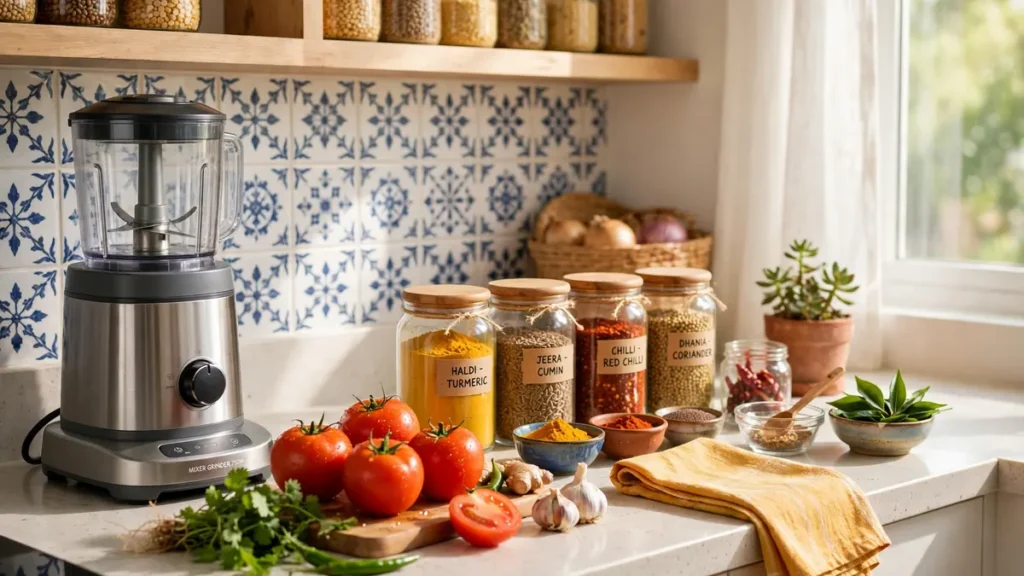
A mixer grinder is the hardest-working appliance in most Indian kitchens. It grinds chutneys in the morning, masalas at lunch, dosa and idli batter in the evening, and dry spices on weekends, often several times a day. Unlike a simple blender, it is built for both wet and dry grinding, for thick pastes and fine powders, and for ingredients that range from soft tomatoes to hard turmeric and whole spices.
Answer: Which Mixer Grinder Suits an Indian Kitchen?
For most Indian kitchens, a 750-watt mixer grinder with three stainless steel jars — a large liquidizing jar, a medium wet-grinding jar and a small chutney jar — suits daily cooking for three to five people. Choose 500 watts for light use, 750 watts for daily masalas and batter, and 1000 watts for large batches.
How Does a Mixer Grinder Differ From a Blender?
A blender, as described in the way a blender mixes and purees food, uses a tall jar and a blade at the bottom to mix liquids, crush ice and make smoothies. It works well for liquids but struggles with thick pastes, because the mixture needs enough liquid to circulate around the blade.
A mixer grinder uses shorter, wider jars and blades designed for grinding, not just mixing. The wet jar handles chutneys and batter, the dry jar handles spices and coffee beans, and the chutney jar handles small quantities that would be lost in a large jar. The cutting action is closer to the high-speed blade grinding used in kitchen grinders, which chops and crushes ingredients into a paste or powder rather than simply stirring them. That is why a mixer grinder, not a blender, is the right tool for idli batter, garam masala and coconut chutney.
What Wattage Do You Actually Need?
Wattage measures the motor’s power, and more watts mean the motor can handle thicker mixtures without slowing down or overheating. A 500-watt motor suits light use: chutneys, milkshakes and occasional spice grinding for one or two people. A 750-watt motor is the practical standard for Indian homes, because it handles daily chutneys, wet grinding and dry masalas without tripping the overload protector often.
A 1000-watt or higher motor suits large families, commercial-style use or homes that grind batter in large batches several times a week. Higher wattage also means more noise and higher electricity use, so there is no benefit in choosing the most powerful motor if your daily use is light. What matters more than the wattage number is the motor’s copper winding, overload protection and warranty, because a well-built 750-watt motor outlasts a cheap 1000-watt motor.
Which Jars Matter, and What Is Each One For?
Most mixer grinders come with three jars, and each has a job. The large jar, usually 1.5 litres, is for liquidizing: lassi, juices, milkshakes and soups. The medium jar, usually 1 litre, is the workhorse for wet grinding: chutneys in larger quantities, dosa batter in small batches and soaked dals. The small chutney jar, usually 300 to 400 millilitres, is for small quantities: a single chutney for two people, a spoonful of garam masala or a small amount of ginger-garlic paste.
Some models add a fourth jar for dry grinding, with a flat blade that grinds spices, coffee and sugar into a fine powder. Stainless steel jars last longer than plastic jars, do not stain from turmeric, and handle hot ingredients better, though they are heavier to lift. Look for jars with a firm lid lock and a handle that stays cool, and check that the jar base fits tightly on the motor unit without wobbling.
What Indian Dishes Depend on a Mixer Grinder?
Coconut chutney, mint chutney, tomato-onion masala base, ginger-garlic paste, garam masala, sambar powder, dosa and idli batter, vada batter, and spice pastes for curries all depend on a mixer grinder in most Indian homes. The difference between a good and a poor result is usually texture: chutney should be smooth but not watery, batter should be fine and aerated, and dry masala should be a uniform powder without large pieces.
For wet grinding, add liquid a little at a time rather than all at once, and stop to scrape down the sides with a spatula so everything reaches the blade. For dry grinding, grind in short bursts of 20 to 30 seconds with pauses in between, which prevents the motor from overheating and keeps spices from losing aroma to heat. For batter, soak rice and urad dal separately, grind the dal first until fluffy, then grind the rice to a slightly coarse texture, and let the batter ferment in a warm place.
How Do You Place a Mixer Grinder in the Kitchen?
A mixer grinder needs a stable, dry counter near a power point, with enough space to lift jars on and off without hitting overhead cabinets. Keep it away from the sink edge, because water splashing into the motor unit is the most common cause of failure, and keep the cord away from the stove. Store jars upside down on a shelf when not in use, so they dry fully and do not develop smell.
If counter space is tight, kitchen layouts with a dedicated appliance corner show how to reserve a fixed spot for the mixer grinder instead of lifting it in and out of a cupboard daily. For daily tidiness, storage ideas that keep mixer jars within reach help with a tray for jars, blades and lids in one place. When a kitchen is planned from scratch, a home planned with a working kitchen should include enough counter length and power points for the appliances a family actually uses every day.
How Do You Clean and Maintain a Mixer Grinder?
Clean the jars immediately after use: rinse, wash with warm soapy water, and dry fully before storing, because dried chutney and batter stain and smell quickly. Wipe the motor base with a damp cloth only, and never immerse the base in water or run water over it. Clean the blade assembly carefully, because dried turmeric and spice residue dull the blade edge and affect grinding over time.
Run the motor in short bursts rather than continuously for several minutes, and let it rest between batches. If the overload protector trips, switch off, unplug, let the motor cool for a few minutes, press the reset button if your model has one, and reduce the load before restarting. Check the rubber gasket in the jar lid regularly; a worn gasket leaks liquid into the motor coupling, which is a common and avoidable repair.
For the wider home, the same tidy-system thinking applies beyond the kitchen: simple systems that keep a kitchen tidy remove friction from daily cooking, and refreshing a kitchen without overspending shows how small, low-cost changes can make the room around the appliances feel new.
What Mistakes Damage a Mixer Grinder?
Grinding very hot liquids in a sealed jar, running the motor continuously until it smells of burning, overfilling jars past the marked level, and grinding hard items such as whole turmeric pieces without breaking them first are the mistakes that damage mixer grinders most often. Another is using the wet jar for dry grinding or the dry jar for wet chutney, which produces poor texture and wears the wrong blade.
Never put a spoon or spatula into a running jar, and never lift the jar off the base while the blade is still spinning. Wait for the blade to stop completely, then remove the jar. A mixer grinder that is cleaned after every use, run in bursts, and stored dry will usually last many years of daily Indian cooking.
Key Takeaways
- A 750-watt mixer grinder with three stainless steel jars suits most Indian kitchens for three to five people.
- The wet jar handles chutneys and batter, the dry jar handles spices, and the small chutney jar handles small quantities.
- A mixer grinder grinds thick pastes and powders, while a blender mainly mixes liquids and smoothies.
- Add liquid gradually for wet grinding, and grind dry spices in short bursts with pauses to protect aroma and motor.
- Clean jars immediately after use, wipe the motor base with a damp cloth only, and never immerse the base in water.
- Run the motor in bursts, respect the jar fill level, and let the motor cool if the overload protector trips.
FAQs
What wattage mixer grinder is best for Indian cooking?
A 750-watt mixer grinder suits daily Indian cooking for most families, while 500 watts suits light use and 1000 watts suits large batches of batter or dry spices.
How many jars should a mixer grinder have?
Three jars suit most homes: a large liquidizing jar, a medium wet-grinding jar and a small chutney jar, with a fourth dry-grinding jar useful for regular spice grinding.
Can a mixer grinder make dosa batter?
Yes, a mixer grinder makes dosa and idli batter well — grind soaked urad dal until fluffy first, then grind soaked rice to a slightly coarse texture, and ferment the batter in a warm place.
How do you clean a mixer grinder?
Wash jars with warm soapy water immediately after use and dry fully, wipe the motor base with a damp cloth only, never immerse the base in water, and check the lid gasket regularly.
Is a mixer grinder better than a blender for chutney?
Yes, a mixer grinder is better for chutney because its shorter jars and grinding blades handle thick pastes and small quantities, while a blender needs more liquid to circulate the mixture.