
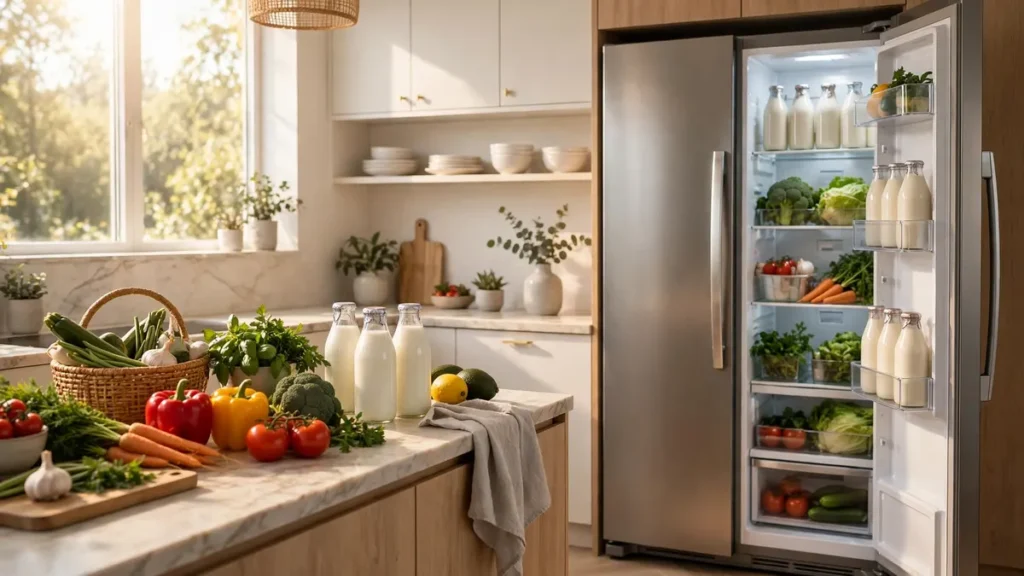
A refrigerator runs day and night, in heat, humidity and dust, and it holds the food a family eats every day. In Indian homes it also faces long power cuts in some areas, voltage fluctuations, crowded kitchens and cooking that produces strong-smelling dishes, pickles and leftovers. Choosing a refrigerator is therefore less about the most features and more about fit: capacity in litres, door style, cooling technology, energy rating and the space in your kitchen.
Answer: Which Refrigerator Suits an Indian Home?
For most Indian families, an automatic-defrost double door refrigerator of 260 to 350 litres suits a household of three to five people, while a single door refrigerator of 170 to 220 litres suits one or two people. Match capacity first, then check energy rating and service support in your city.
What Are the Main Types of Refrigerators?
A single door refrigerator has one door, a small freezer box inside the main compartment, and direct-cool cooling, which means frost builds up and needs manual defrosting from time to time. It costs the least, uses less electricity and suits small households, paying guests and rented homes. Its limits are a small freezer, no separate vegetable crisping zone and manual defrosting.
A double door refrigerator has separate doors for the fridge and the freezer, automatic-defrost cooling that prevents ice build-up, and a larger freezer that handles frozen vegetables, ice cream and bulk meat storage. It suits families that cook daily and store leftovers, and it usually offers a vegetable crisper, bottle racks and a convertible compartment in higher models. It costs more and needs more floor space than a single door model.
A side-by-side refrigerator places the fridge and freezer next to each other vertically, with wide shelves, a large freezer and often a water and ice dispenser. It suits large families and homes with big kitchens, but it needs a wide doorway and floor area, and it consumes more electricity than smaller models. A French door model, with two fridge doors on top and a freezer drawer below, offers similar space with easier access to fresh food at eye level.
The history of home refrigeration shows how the refrigerator replaced the icebox in the early twentieth century, and the science of refrigeration explains the vapour-compression cycle that moves heat out of the cabinet and keeps food cold.
How Much Capacity Do You Need?
Refrigerator capacity is measured in litres, and the common Indian rule of thumb is 50 to 70 litres per person plus a base allowance for shared storage. A 170 to 200 litre refrigerator suits one or two people; 230 to 290 litres suits three people; 300 to 350 litres suits four to five people; and 400 litres or more suits larger joint families or homes that store food in bulk.
Think about your actual habits, not just headcount. A family that cooks fresh food daily and shops every two days needs less space than a family that shops once a week, stores large vessels of dal and curry, keeps several milk packets and freezes seasonal mangoes or peas. If your fridge is always packed to the door, cold air cannot circulate and food at the back stays colder than food at the front, which is a sign the capacity is too small.
What Do Temperature Settings Actually Mean?
The United States Food and Drug Administration recommends keeping a refrigerator at or below 4 degrees Celsius and a freezer at minus 18 degrees Celsius, and the optimum range for perishable food storage is widely given as 3 to 5 degrees Celsius. In practice, most Indian refrigerators use a dial numbered 1 to 5 or 1 to 7, where a higher number means colder, not a temperature in degrees.
Set the fridge compartment so milk stays fresh for its full shelf life without freezing vegetables near the cooling vent, and set the freezer so ice cream stays firm and frozen food shows no soft spots. In summer, move the dial one step colder, because the compressor works harder against hot kitchen air; in winter, move it one step warmer. Avoid the coldest setting permanently, which wastes electricity and can freeze leafy vegetables and milk.
How Should You Organize Food Inside a Refrigerator?
Place raw meat and fish on the lowest shelf in a covered container so juices cannot drip onto cooked food below. Keep milk, curd and leftovers in the middle shelves, where the temperature is most stable. Store vegetables in the crisper drawer, which holds humidity and keeps greens fresh longer, and keep fruits separate from vegetables where possible, because some fruits release ethylene gas that speeds ripening.
Do not block the air vents inside the cabinet with large vessels pushed against the back wall. Cold air needs space to circulate, and blocked vents create warm pockets where food spoils faster. Keep the door shelves for items that tolerate temperature swings, such as sauces, pickles and bottled drinks, and keep eggs in their carton on a shelf rather than in the door, where the temperature changes every time the door opens.
How Do You Place a Refrigerator in the Kitchen?
Leave at least a few centimetres of clearance behind and on the sides of the refrigerator so heat from the compressor can escape, and keep it away from direct sunlight and the cooking stove, which force the compressor to run longer. Place it on a level floor, using the adjustable feet if the floor slopes, because a tilted refrigerator can make the door seal uneven and let warm air in.
If the kitchen is being planned or rearranged, kitchen layouts that fit a large refrigerator show how to reserve a ventilated corner with a nearby power point and enough door swing space. For daily use, kitchen storage ideas that keep fridge supplies in order help with baskets, labelled containers and a fixed spot for milk, curd and leftovers. When a home is built from scratch, planning a kitchen around a refrigerator space avoids the common problem of a fridge squeezed against a wall where the door cannot open fully.
How Do You Clean and Maintain a Refrigerator?
Clean the interior every two to four weeks: remove food, wipe shelves and drawers with warm water and a mild soap or baking soda solution, and dry before putting food back. Wipe spills at once, because dried curry and milk stains attract smell and bacteria. Clean the door gasket with a damp cloth and check that a slip of paper held in the closed door resists pulling out; a loose gasket leaks cold air and raises the electricity bill.
Vacuum or brush the condenser coils at the back or below the unit every six months, especially in dusty homes, because dust on the coils makes the compressor work harder. Keep the refrigerator reasonably full, since a full fridge holds its temperature better than an empty one during a power cut, but do not overfill it to the point where air cannot move. During a long power cut, keep the door closed as much as possible; a closed refrigerator keeps food safe for about four hours.
For the wider home, the same tidy-system thinking applies beyond the kitchen: a tidy system for the whole home removes friction from daily routines, and interior choices for a kitchen corner can make a large appliance blend into the room instead of dominating it.
What Mistakes Shorten a Refrigerator’s Life?
Putting hot food straight into the fridge, overloading it so air cannot circulate, keeping the door open while deciding what to eat, and ignoring a damaged door gasket are the habits that wear a refrigerator out early. Another is placing it next to the stove or in direct sun, which forces the compressor to run almost constantly in summer. Voltage fluctuations without built-in stabilizer protection can also damage the compressor over time, so check that the model is rated for your area’s supply.
A refrigerator is a ten-to-fifteen-year appliance, so a slightly larger capacity, a higher star rating and a brand with service centres in your city are worth more over its life than a dispenser or a touch display that adds cost without keeping food fresher.
Key Takeaways
- Match capacity to household size: 170 to 200 litres for one or two people, 230 to 290 litres for three, 300 to 350 litres for four to five.
- Single door models cost less and suit small households; double door automatic-defrost models suit families that store leftovers and frozen food.
- Keep the fridge at or below 4 degrees Celsius and the freezer at minus 18 degrees Celsius, adjusting the dial one step with the season.
- Store raw meat on the lowest shelf, vegetables in the crisper, and door shelves only for sauces, pickles and drinks.
- Leave clearance behind the unit, keep it away from the stove and sunlight, and clean the gasket and coils regularly.
- Never overload the cabinet, block the air vents, or put hot food straight into the fridge.
FAQs
What size refrigerator is best for a family of four?
A 300 to 350 litre double door refrigerator suits a family of four for daily cooking and weekly shopping, while a 400 litre or larger model is better for joint families or bulk storage.
Is a single door or double door refrigerator better?
A single door refrigerator costs less and uses less electricity, while a double door refrigerator offers automatic-defrost cooling, a larger freezer and more organized storage, so the better choice depends on household size and budget.
What temperature should a refrigerator be set at?
A refrigerator should be kept at or below 4 degrees Celsius and the freezer at minus 18 degrees Celsius, with the dial moved one step colder in summer and one step warmer in winter.
How do you clean a refrigerator?
Remove all food, wipe shelves and drawers with warm water and mild soap or baking soda solution, clean the door gasket with a damp cloth, dry everything, and clean the condenser coils every six months.
How long does food stay safe in a refrigerator during a power cut?
A closed refrigerator keeps food safe for about four hours during a power cut, so keep the door closed as much as possible and discard perishable food that has been above 4 degrees Celsius for longer than that.